
Introduce
A controlled vapour stream carries target molecules through the inlet into the reaction region. Stable flow and efficient transport help maintain sensitivity while reducing contamination and carryover.
Ion mobility spectrometry separates and detects trace gas-phase ions according to how they move through an electric field. It is applied to direct vapour and gas-phase monitoring, providing rapid on-site warning for selected chemical warfare agents and toxic industrial chemicals.

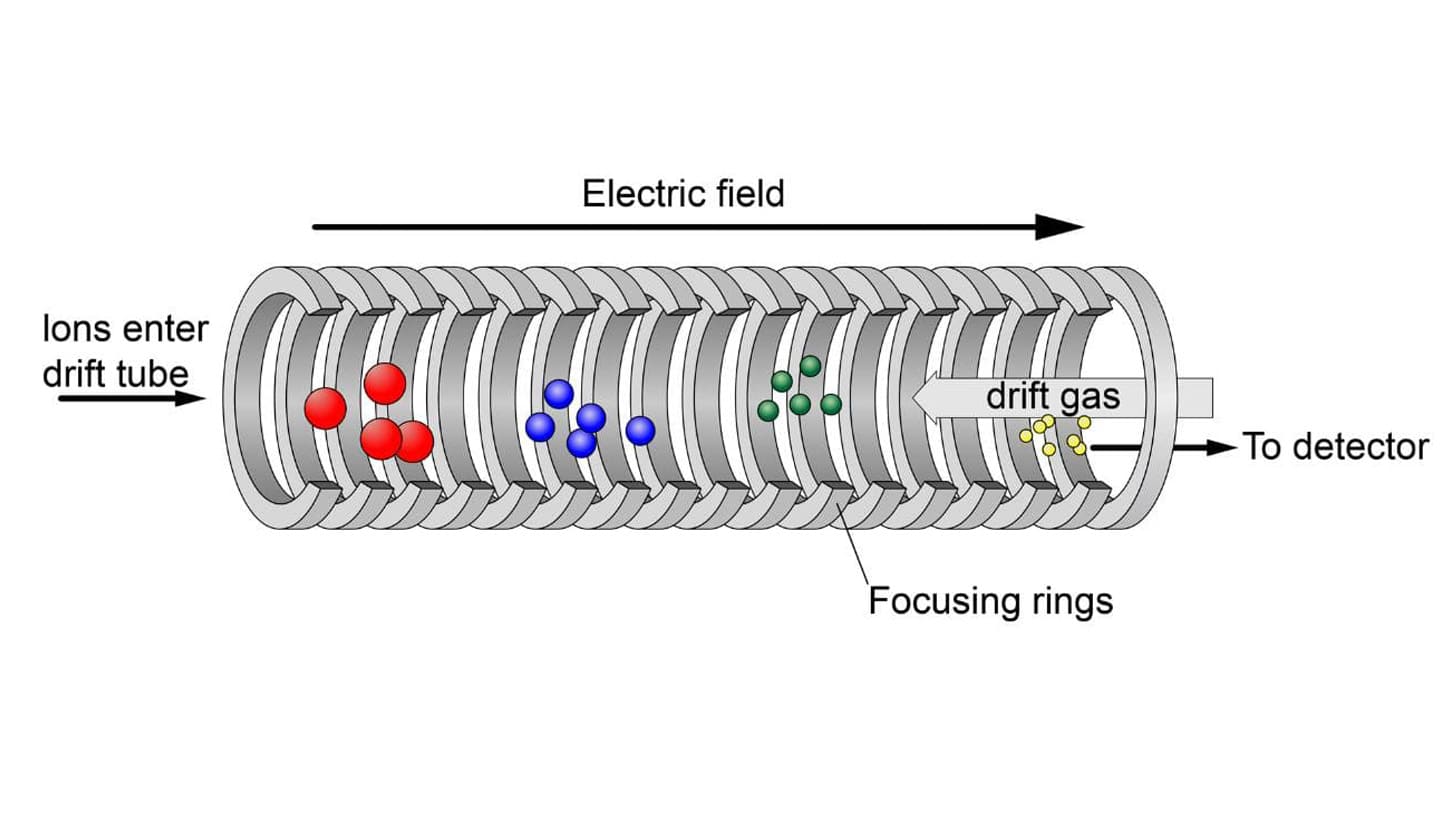
Ion mobility spectrometry systems are configured for direct analysis of vapours and gases in air. A controlled inlet draws the gas sample into the reaction region, where target molecules form ions through defined ion-molecule chemistry. The ions then enter a drift tube operating near atmospheric pressure and move through a clean drift gas under a uniform electric field.
Collisions with the drift gas cause different ion species to travel at different mobilities. The detector records their arrival times and produces a mobility spectrum. Peak position, shape, intensity and polarity are evaluated together against validated target criteria; no single peak should be treated as a universal chemical fingerprint.
This configuration supports fast warning for selected vapour-phase chemical warfare agents and toxic industrial chemicals. Performance depends on the target, concentration, humidity, temperature, pressure, interferents, sampling flow and alarm method, so stated detection limits and response times remain product- and method-specific.
A vapour or gas sample is drawn directly from the monitored atmosphere and converted into ions in a controlled reaction region. An ion gate releases a packet of those ions into a drift tube where an electric field moves them against a clean drift gas.
Smaller or more compact ions generally travel differently from larger clustered ions because their collisions with the drift gas differ. The time taken to reach the detector produces a mobility spectrum whose peak positions and shapes can be compared with validated target signatures.
Temperature, pressure, humidity, reagent chemistry and sample matrix influence ion formation and mobility. Stable flow, environmental compensation, selective sample handling and well-designed alarm logic are therefore essential to reliable field identification.
IMS combines sampling, ion chemistry and time-based separation in a fast analytical cycle. Controlling each stage protects selectivity at trace concentration.
A controlled vapour stream carries target molecules through the inlet into the reaction region. Stable flow and efficient transport help maintain sensitivity while reducing contamination and carryover.
The analyte forms characteristic ions through controlled ion-molecule reactions. Reagent chemistry and polarity are selected for the target class.
An electric field moves gated ions through the drift gas at different velocities. Their arrival times create a mobility spectrum with separable peaks.
Algorithms correct the spectrum and compare peak position, shape and intensity with target criteria. Alarm logic balances sensitivity against realistic interferents.
Gas-flow control, ion chemistry and environmental compensation can matter as much as the resolving power of the drift region.
A controlled vapour flow carries target molecules into the ionisation region. Stable flow and clean transport paths help preserve sensitivity, minimise carryover and maintain repeatable performance.
Mobility changes with temperature, pressure and moisture. Sensors, flow regulation and normalisation keep library comparisons meaningful across operating conditions.
A credible alarm considers more than a single peak. Multi-parameter matching, interferent rejection and quality checks reduce false decisions at trace levels.
Direct gas sampling: a controlled inlet draws vapour-phase analytes from the monitored atmosphere into the ionisation region.
Fast separation: millisecond-scale ion drift supports rapid analytical cycles and timely alarms.
Controlled recognition: ion chemistry, polarity, drift time, peak shape and intensity are evaluated together against validated target criteria and known interferents.
Concentration indication: for validated target gases, IMS gives a relative indication of concentration, typically low, medium or high, and tracks how that level changes during continuous or repeated sampling. Precise quantitative values require target-specific calibration.
Tell us about your environment, target substances and operational requirements. We’ll help map the right path.
Start a conversation