
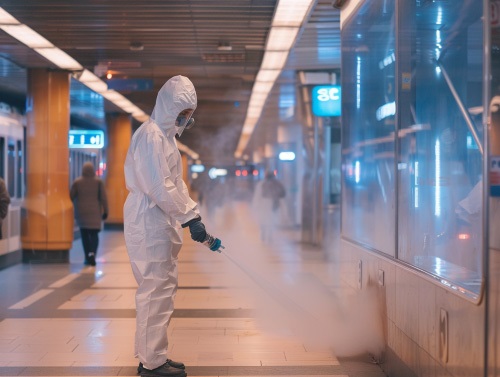
Operational scenario

Real-Time Monitoring of Biological Airborne Aerosols

Continuous bioaerosol sensing establishes facility baselines, detects significant particle changes and triggers controlled sampling for laboratory identification.

Real-Time Monitoring of Biological Airborne Aerosols
Continuous biological-particle monitoring with targeted sample collection.
Operational context

High-risk healthcare and research facilities need early awareness of unusual airborne biological-particle behaviour without confusing an optical alarm with a diagnosis. Monitoring locations are selected using airflow, occupancy and critical-room information.

HT-Nova continuous monitors can track particle and fluorescence characteristics, while connected samplers preserve material from defined events for laboratory follow-up.

Operational challenge

Operational challenge

Pollen, dust, cleaning activity, humidity and ventilation changes can alter the signal. Reliable operation therefore depends on site-specific baselines, alarm governance and a documented confirmation pathway.

Operating workflow

Operating workflow

01

Define the baseline

Characterize normal particle behaviour for the location, occupancy pattern, ventilation state and season.

02

Monitor

Use continuous sensing to identify a significant change in biological-particle characteristics, not to claim a pathogen identity.

03

Collect

Trigger targeted sampling with controlled collection media, location records and contamination precautions.

04

Analyse

Transfer samples to an appropriate laboratory workflow for organism-specific or molecular identification.

05

Interpret

Combine sensor trends, environmental context and laboratory evidence before escalating or closing the event.

Technology role

Technology role

Real-time optical monitoring provides trend and anomaly information. Targeted sampling and an appropriate laboratory method provide organism-specific evidence; the two stages must remain time- and location-linked.

Technical boundaries

Technical boundaries

The monitor does not identify a bacterium, virus or fungus solely from a fluorescence alarm and cannot identify an infection source by itself. Clinical or public-health conclusions remain with the responsible authority.

Mission value

Mission value

01

Earlier awareness

Operators see a meaningful departure from the facility baseline.

02

Controlled confirmation

Defined alarms initiate documented sample collection and laboratory follow-up.

03

Operational context

Airflow, occupancy and activity remain connected to the event record.

Talk to an expert

Discuss your detection requirements.

Tell us about your environment, target substances and operational requirements. We’ll help map the right path.

Start a conversation