
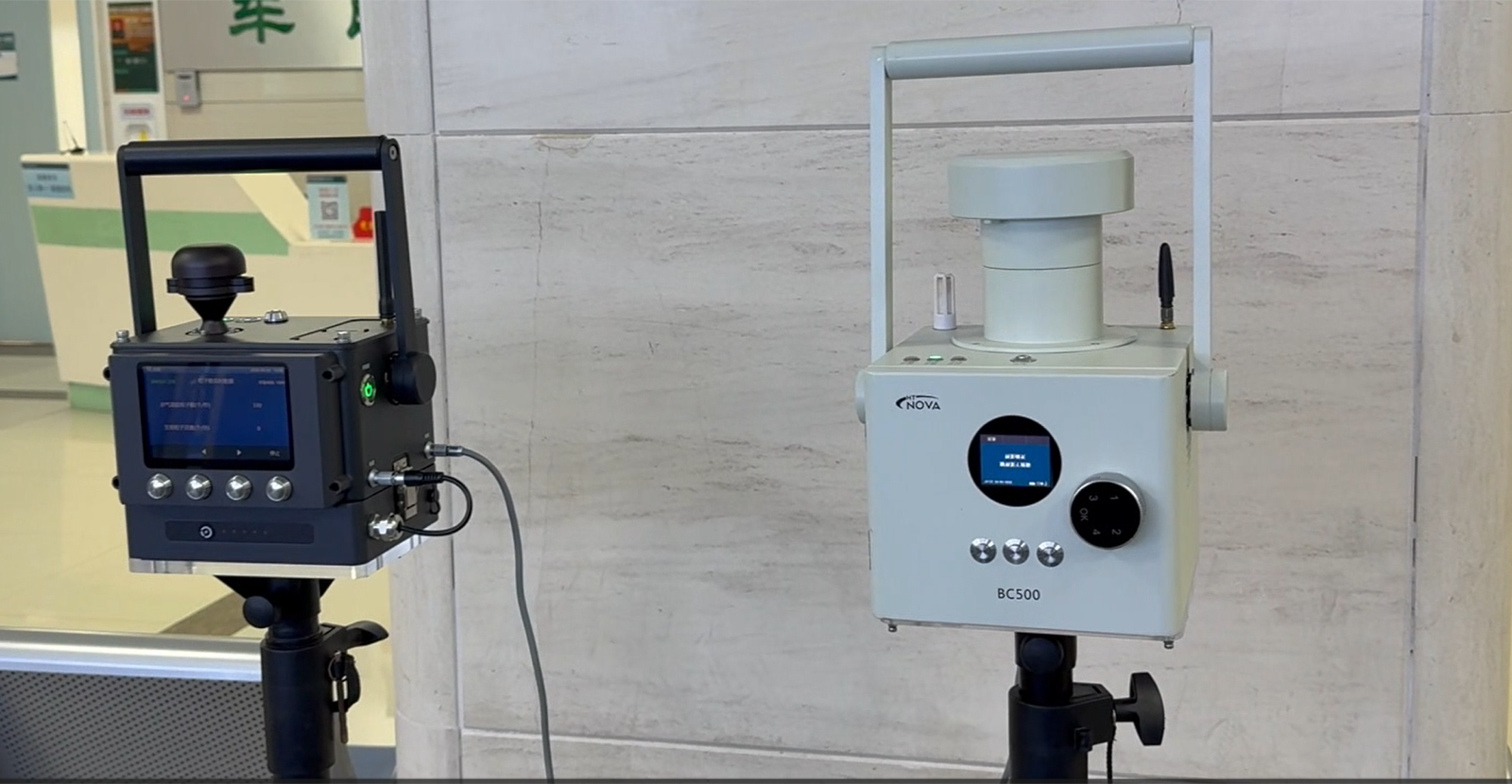
Operational scenario

Airborne Biological Monitoring in a High-Risk Facility

An illustrative scenario for continuous bioaerosol monitoring that establishes a baseline, detects abnormal changes and supports targeted sampling for laboratory identification.

Fixed bioaerosol monitor in a controlled high-risk facility corridor
Continuous biological-particle monitoring linked to baseline, sampling and laboratory follow-up.
Operational context

Biological laboratories, healthcare environments and other controlled facilities may require continuing awareness of changes in airborne biological particles. The useful starting point is an understanding of the facility's normal environmental pattern, rather than assuming that every change identifies a specific organism.

This illustrative operating scenario follows the appropriate sequence: establish a baseline, monitor continuously, investigate an abnormal change and conduct targeted aerosol sampling where required. Laboratory processes identify organisms from suitable samples; monitoring supports the decision to investigate and does not automatically identify a pathogen.

Operational challenge

Detect a change without over-interpreting it

Airborne biological particle levels can vary with occupancy, ventilation, work activity and the environment. A monitoring result is most useful when it is compared with a relevant baseline and investigated in context.

An abnormal change can trigger targeted sampling and a review of conditions. It is not itself an automatic determination of the organism, source or health significance.

Operating workflow

Baseline-to-investigation workflow

01

Baseline

The facility establishes a view of normal environmental patterns across relevant locations and operating periods.

02

Continuous monitoring

The system observes changes in airborne biological-particle indicators over time.

03

Abnormal change

A deviation from the relevant pattern prompts a proportionate review rather than an immediate attribution.

04

Alarm

The responsible team receives a notification according to the configured thresholds and operating procedures.

05

Targeted sampling

Appropriate sampling is directed to the location, period or condition requiring further examination.

06

Laboratory identification

Suitable samples are examined through laboratory methods to determine what can be identified.

07

Response

Responsible organizations decide on environmental, operational or public-health actions under their procedures.

Technology role

Monitoring, sampling and laboratory workflow

A bioaerosol monitor provides continuous indication of changes in airborne biological-particle conditions. A sampler creates a path to collect material for further examination, while the data platform helps correlate the observation with time, location and operating conditions.

The technologies support a monitoring-to-investigation workflow. Laboratory methods, not a monitoring alarm alone, are responsible for identifying organisms from suitable samples.

Mission value

Biological-monitoring capability

01

Environmental baseline

Continuous observations help establish what normal variation looks like in a specific facility context.

02

Abnormal-change awareness

Configured monitoring can bring unusual changes to the attention of responsible teams.

03

Targeted aerosol sampling

Sampling can be directed by the monitoring context instead of performed without a defined investigative question.

04

Laboratory identification pathway

Collected samples can move into appropriate laboratory workflows for identification and further interpretation.

Technical boundaries

Technical boundaries

Optical fluorescence and particle measurements indicate changes in airborne biological-particle characteristics; they do not identify a pathogen or establish health significance. Baselines must reflect location, occupancy, ventilation, process and season. Suitable sampling and laboratory methods provide organism-specific evidence.

Talk to an expert

Discuss your detection requirements.

Tell us about your environment, target substances and operational requirements. We’ll help map the right path.

Start a conversation